
Portage Previous Residents by Era
Different sources answer different parts of an address-history question. County deeds establish transfers and named parties; directories and census material help with people at an address; city property material provides current parcel context. The source below should be chosen for the date being tested, not for convenience. A current owner record does not prove who lived there in an earlier period, and a directory entry does not prove a legal title chain.
| Record route | Documented coverage | Keeper or access point | What it can contribute |
|---|---|---|---|
| Kalamazoo County land records | Images back to 1831; index complete through 1984, with more work underway | Register of Deeds, WebTecs, counter | Named grantors and grantees, instrument references, copy route |
| KPL deed microfilm | Deeds 1831-1903 through Liber 70; grantor/grantee index 1831-1903 | Kalamazoo Public Library | Earlier county deed and index trail |
| KPL city directories | First Kalamazoo directory 1860; holdings have gaps | KPL Local History | Household and street-order clues |
| Telephone and criss-cross volumes | Telephone from 1913, broad coverage from 1949; criss-cross from 1954 | KPL Local History | Address or telephone-order surname leads |
| Federal census microfilm | 1820-1930 holdings | KPL Microfilm | Household-level comparison for a period |
For a recent transfer, begin with the current Portage parcel and the county deed chain. For an earlier household, move to the nearest directory, telephone, or criss-cross volume, then use census and newspaper material to test the address. KPL’s microfilm holdings are a key fallback when the online route does not supply an older index or image.
The Kalamazoo County Register of Deeds explains the county’s deed coverage, name-first searching, and copy choices.
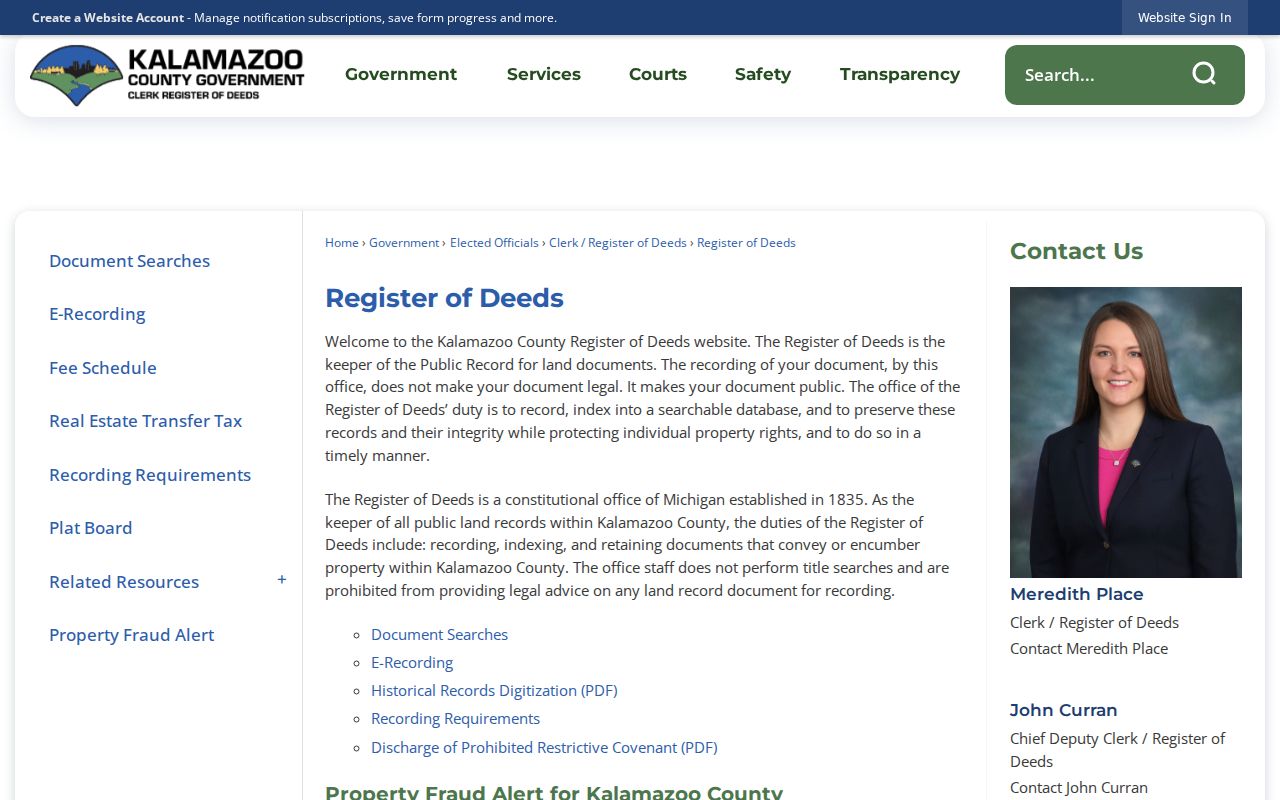
The register is the durable land-record source for Portage, but each result still needs to be compared with the correct address and period.
Portage Past Residents Start at Parcels
Use Portage Property Records to establish the current parcel context before looking for past residents. The city describes owner, tax, land, building, sale, and zoning information, and warns that its BS&A data are updated daily but not guaranteed. The Portage GIS adds address, owner, parcel number, plat, and intersection searching, plus approximate boundaries and historic aerial layers.
Record the current street address, parcel number, legal description if available, and present owner separately. A situs address is the physical location of a parcel. A tax or owner mailing address is a correspondence location and may be elsewhere. The research did not capture the live field labels for those two address types, so neither should be used as occupancy proof without a dated supporting source.
Note: A parcel number is a useful cross-check, but an address and named party are still needed for the backward trail.
Portage Address History Reaches 1831
Kalamazoo County land records and images reach back to 1831. The county reports that the index is complete through 1984, with additional indexing in progress. In 2024, the county announced that US Imaging had scanned more than 1.5 million historical land documents and index books and that Fidlar had uploaded the material. This expanded online access, but it did not turn old documents into a complete modern owner database.
The county-linked WebTecs Deeds Search provides the free basic index route. It supports name, date-range, liber/page, document-number, and parcel-number searches. Its documented name mode is grantor/grantee. The source review did not capture a live result screen or a deed image, so no named deed entry, book reference, parcel, or supposed result is presented here as a sample.
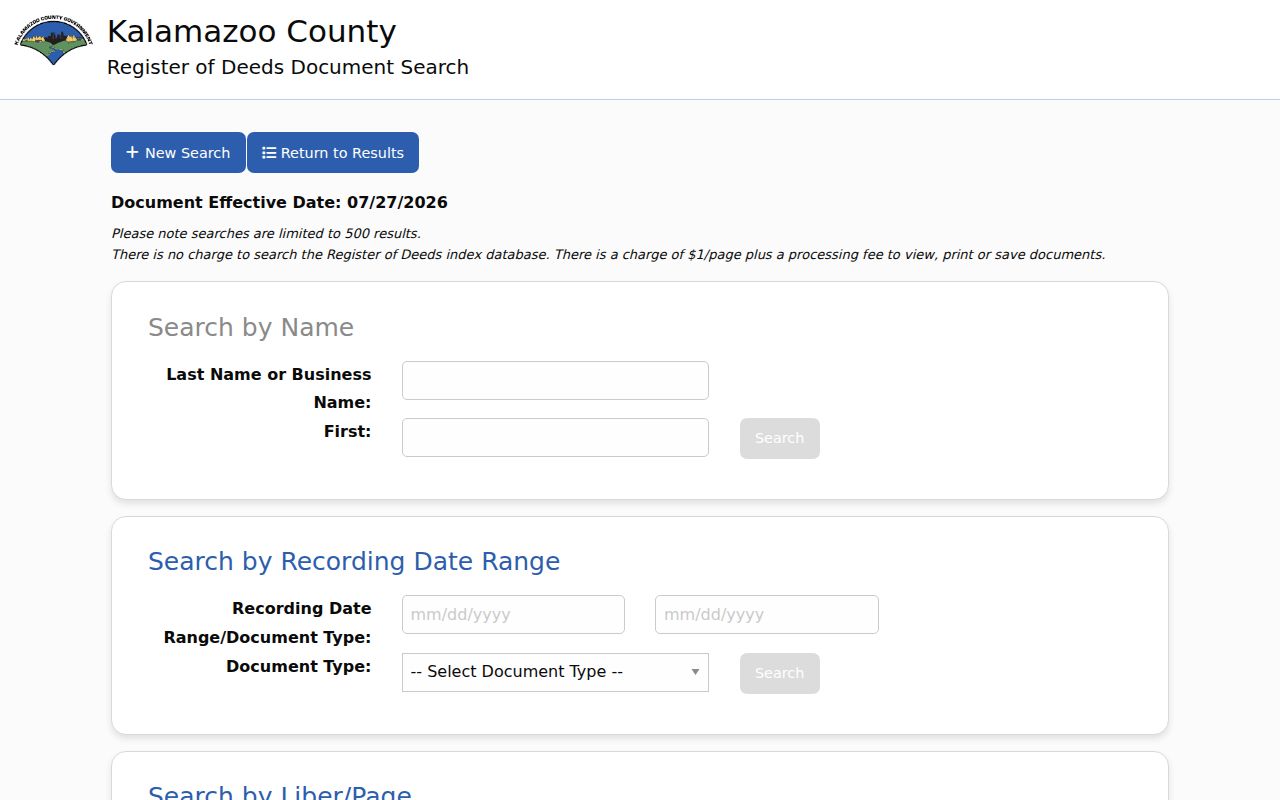
The interface is an access route, not a substitute for checking the parties, recording context, and copy information documented by the county.
Portage Past Residents Need Name Searches
The county specifically recommends a name-first approach because its land index is built around grantors and grantees. An address is not required, and an address search can be incomplete. Once a current buyer or seller is identified, search that name in the relevant party role and preserve the instrument date, liber/page, document number, or parcel reference when the index supplies it.
| Grantor | The person or entity transferring an interest in the recorded instrument. |
|---|---|
| Grantee | The person or entity receiving that interest in the recorded instrument. |
| Liber/page | A book-and-page reference used to locate an older recorded instrument. |
| Document number | A recorded-document reference that helps distinguish similarly named transfers. |
| Parcel reference | A cross-check tied to a property, not a replacement for a party-name search. |
Warranty deeds, quitclaim deeds, land contracts, mortgages, assignments, releases, liens, plats, easements, restrictions, and transfers can appear in the county record system. Not every one proves an ownership change. The Register of Deeds records, indexes, preserves, and makes public land records, but it does not perform title searches or provide legal advice.
Tracing Portage Previous Residents by Deed
A chain of title follows recorded property transfers backward. It is useful for finding past owners, not for declaring who occupied a home at a given moment. Pair the chain with directories, census, and other dated sources before drawing a household conclusion. Keep a simple log of each transfer and the source that supplied it so the next search begins from a recorded reference rather than a memory.
- Capture the current owner and available legal description from the Portage parcel record.
- Search the current owner as grantee in the county deed index and identify the purchase instrument.
- Use the seller named in that transfer as a grantee search to locate the seller’s earlier purchase.
- Repeat the party-to-party search backward, preserving the date, liber/page or document number, and parcel reference when present.
- For an older or difficult name, contact the county deed office or use KPL and FamilySearch microfilm routes rather than assuming the chain ends online.
- Chain of title
- A sequence of recorded transfers used to trace interests in a property backward.
- Legal description
- The land description used in a recorded instrument; it is often more stable than an old street address.
- Occupancy
- Evidence that a person lived at an address, which requires support beyond a deed alone.
The FamilySearch Kalamazoo deed catalog identifies courthouse microfilm for deeds from 1831 through 1901 and indexes from 1831 through 1903. It is a second research path when an online name search is weak.
Portage Past Addresses Changed in 1925
Portage previous residents can be hidden by address history. KPL reports that no 1925 Kalamazoo directory exists because the citywide numbering system changed that year. Compare 1924 and 1926, then consult the 1932 Sanborn material for old and new house numbers. This three-part check is better than forcing an older number into a modern street search.
Test street-name changes as well. KPL lists Cork and St. James, Michigan Avenue and Main, Oakland and Asylum, Riverview and Seminary, and several other historic variants. The Library of Congress Sanborn map listing is a map route for building and address context, but a map alone does not establish a resident.
Note: Match the old number, street variant, and directory year before deciding a property record concerns the same address.
Portage Previous Residents in Directories
Deeds show a legal party trail. City, telephone, and criss-cross directories can add the household layer, including renters or boarders who never appear in a deed chain. KPL’s first city directory is from 1860, street-order material begins in 1897, telephone holdings begin in 1913, and criss-cross volumes begin in 1954. The directory collections themselves, including county, suburban, and rural coverage limits, are detailed in the Portage directory book.
Pair a directory date with the nearest KPL census microfilm period. Then test a disappearance with Gazette obituaries, marriage notices, local clippings, cemetery material, or the probate index where the date and name fit. This sequence can separate an ownership transfer from a household move, but neither a directory nor a census should be stretched beyond its own date.
Lawful use. Portage previous-resident research supports family history, estate work, property history, and personal curiosity. Do not publish bulk address lists, repeatedly target a person, or use public records to stalk, harass, or harm anyone.
Portage Deed Records and Four Paths
County deed access has several routes. Use the one that fits the period, need, and budget, then retain the same party and reference information across routes. WebTecs is the free index entry point. County office public workstations offer free grantor/grantee searching. Tapestry supplies one-time access, while Laredo is a subscription program. Staff can perform a limited property search, but they will not conduct an in-depth title search or abstract.
| Access channel | Cost or account rule | Useful for | Limit to remember |
|---|---|---|---|
| WebTecs basic search | Free index search; images carry page and processing or technology charges | Name-first deed index work | Image access is not free and no sample result was captured |
| County public workstation | Free grantor/grantee search; prints $1 per page | In-person index use | Requires the county office route |
| Tapestry EON | $8.75 one-time search, effective October 21, 2024; standard images $1 per page | Credit-card access for nonmembers | Paid search channel |
| Laredo | Monthly fee and agreement | Subscriber access | Downloadable program and subscription required |
| Staff lookup | $5 per property search, plus $1 per page or image; certified copies add $5 | Limited office-assisted search | Not a title search or abstract |
For pre-1985 name searching, the county says staff guidance may be needed at Room 102 or through deeds@kalcounty.com and 269-383-8970, even when a scanned image exists. The Clerk/Register of Deeds office is at 201 W. Kalamazoo Avenue, Kalamazoo. Its listed hours are Monday, Tuesday, Thursday, and Friday from 8 a.m. to 4:30 p.m., and Wednesday from 9 a.m. to 4:30 p.m.
Limits of Portage Previous Resident Records
A deed is evidence of a recorded transaction, not automatic proof of ownership at every date, occupancy, family relationship, or a clear legal title. County materials make the same boundary explicit: the Register of Deeds does not perform title searches or give legal advice. A modern parcel display is not a complete historical chain, and a scanned older image may be difficult to search by name. Preserve what the index actually shows instead of filling gaps with assumptions.
The county’s free Property Fraud Alert monitors names for new recordings and sends an early warning. It does not stop a filing, establish ownership, or replace title research. In 2023, the county reported 1,090 subscribers in the service’s first seven months after its October 2022 launch. Treat an alert as a prompt to check the official record and seek qualified help for title questions.
Note: The absence of a captured live deed result is a research limit, not permission to invent an entry or a chain.