
Portage Resident Lookup Record Paths
Every good search to look up a resident begins with one narrow question. The record that answers it does the real work. Portage property and GIS tools give current parcel context. The county deed index traces ownership backward. Michigan's voter tools can confirm election registration details. Court indexes, probate files, vital records, cemetery lists, licenses, and library archives each contribute a different slice of evidence. None of them is a master roster of who lives in Portage today. A name can surface in one system, and it may be missing from all the rest.
Portage sits inside Kalamazoo County, so city and county layers work as a pair. The Portage Property Records page covers an individual parcel. Portage GIS adds address, owner, plat, intersection, and parcel-number context. Treat an owner or mailing address as a lead, not proof of residency. For older land ties, Kalamazoo County Document Searches works by name. County staff caution that address searching there can come back incomplete.
| Record trail | Question it can help answer | Custodian or search | Access route |
|---|---|---|---|
| Parcel and deed record | Current parcel context or a recorded ownership link | Portage property tools; Kalamazoo County Register of Deeds | City web tools, deed index, counter, staff search |
| Election registration | Whether official voter information can be confirmed | Michigan Voter Information Center and election offices | Public lookup and records routes with withheld fields |
| Court and probate index | A case, estate, fiduciary, or court location | MiCOURT; Kalamazoo County Probate Court | Online index, clerk or court-terminal follow-up |
| Vital record | A qualifying birth, marriage, or death fact | Kalamazoo County Clerk or Michigan Vital Records | Public, genealogy-period, or eligibility-based request |
| Cemetery or historical source | An interment lead or family-history clue | Portage cemetery tools; Portage District Library | Name search, GIS search, clerk, Heritage Room |
Let the fact you already hold decide the first stop. A full name plus a recent street address points straight to a parcel check. A known death or estate matter suggests cemetery, probate, or vital records instead. And a name pulled from a local history project may take a library or archive visit before it can link to modern Portage records.
Portage Court Name Searches
The statewide MiCOURT gateway sorts cases by category. The MiCOURT Case Search categories are Civil, Traffic, Criminal, Domestic/Divorce/Family, and Probate. Begin with the full legal name and the likeliest category. A common name is just a lead. Hold onto the court, case number, filing date, and status before deciding a result truly concerns the person you want. MiCOURT is an index-style case-history gateway. It is not a complete scanned court file. The MiCOURT search capture displays the state gateway and its category choices. Pick a court category before treating any name result as a Portage connection.
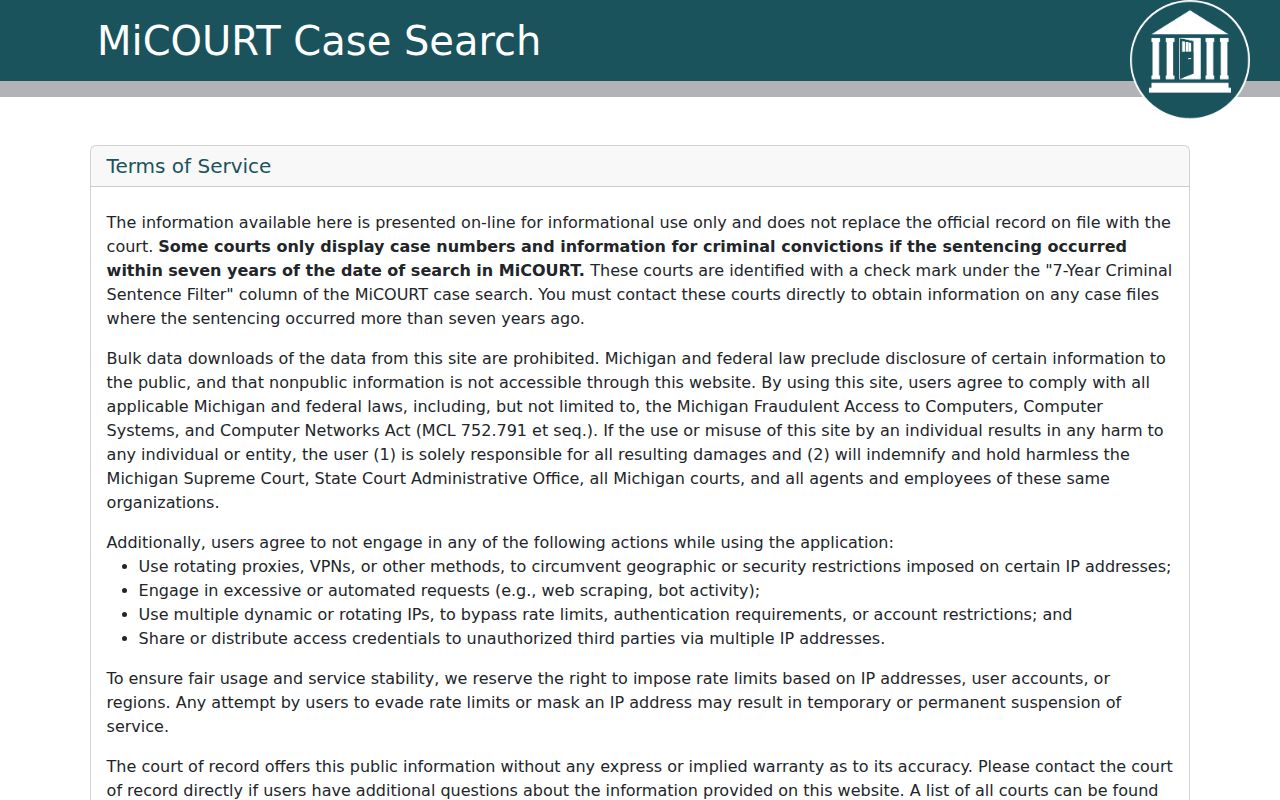
Local follow-ups split by court. The 8th District Court handles district-court criminal matters. The 9th Circuit Court and Family Division follow separate access paths. Kalamazoo County offers no general online portal for Circuit Court case records. Public portions get reviewed at the Gull Road Justice Complex or Pratt Justice Center on paper or at a terminal. Federal cases run through PACER's party and name locator once you register for free. Court records do not flow through county FOIA requests.
| Result item | What it means |
|---|---|
| Case number | The identifier to give the court clerk when asking about a specific file. |
| Case type and court | The category and court location, useful for separating similarly named people. |
| Parties and attorney | Index information that can support a two-source check, not identity proof on its own. |
| Status, filing date, and history entries | A snapshot of the indexed case path, not a certified disposition or full record. |
Protected categories never show up as ordinary results. Adoption, juvenile, sealed, expunged, protected family, mental-health, and sequestered matters may all sit behind restrictions. Some online criminal display is capped at seven years. Older matters can require a direct court request. Note: Pair any court index match with a separate date, address, case number, or family clue before relying on it.
Portage Probate Estate Connections
For a Portage estate trail, the clearest local route is the Kalamazoo County Probate Court index. The court describes its search as real-time as entered, apart from sequestered material. Coverage reaches back to 1832. A more detailed index runs from 1995 forward, and active older matters are added over time. A search can surface an estate, a guardianship, or a fiduciary relationship. It can also yield a case number that points toward the proper file.
Three views carry the weight when you look up a resident this way. They are Case Detail, Fiduciary, and Index document entries. The online index carries no images, and not every underlying document has been digitized. Take the case number to Probate Court for a specific record. Or use the court's copy-request process. County policy allows inspection or copying unless a rule, statute, or order restricts the record. Active files may be reviewed within a limited appointment window. Pulling archived material can take longer.
- Docket
- A court's chronological record of activity in a case, often shown as index or history entries rather than the papers themselves.
- Index and image
- An index points to a record through names, dates, or numbers. An image is a view of the document, and it may be unavailable online.
- Certified copy
- A copy issued through the custodian's official process for a purpose that requires certification, rather than an informal printout.
- Fiduciary
- A person or institution authorized to act for an estate, trust, guardianship, or similar court matter.
Portage Vital Record Windows
Kalamazoo County keeps birth and death records from 1867. Marriage records go back to 1831. Its genealogy guidance explains what each window covers. Michigan law treats these types differently. Births are restricted under MCL 333.2882. The person named can request a copy. So can a parent, a legal guardian, a qualifying heir, a court, or an authorized representative. Older records qualify too. Under MCL 333.2885, genealogy access opens after 110 years for a birth. For a marriage or death, it opens after 75 years.
There is no single search box at the county clerk. Instead, the office offers several channels. A birth request can go online, in person, by mail, drop box, or fax with the required identification. Death and marriage certified copies use online, in-person, mail, and fax channels under the county's copy procedure. Timing varies by channel. The county says an in-person birth request may be handled the same day. Mailed orders go out within five business days after processing. The birth page estimates a newborn record at two to three weeks. The certified-copy form says five to ten days. Confirm with the clerk before relying on either estimate.
For a resident lookup, a public marriage or death copy can corroborate a relationship or an event. A restricted birth record is never a routine name-search result. The state Michigan Vital Records office covers statewide requests. The local clerk serves as county registrar for records tied to Kalamazoo County. Note: A vital index, a plain copy, and a certification are separate access levels with different rules.
Confirming a Portage Resident Match
Treat two Portage results as one person only after matching two independent clues. A name alone proves little. A name with an exact address and year is far stronger. A spouse or parent from a lawful vital-record route, a clerk-confirmed cemetery plot, a case number, a license number, or a parcel chain each make a useful second clue. Label each source as current, historical, filed, or merely indexed. That habit keeps an old listing from masquerading as a current residence.
- Begin with the known name, likely name variant, approximate year, and one non-sensitive detail such as a street or family connection.
- Use Portage property or GIS tools for current parcel context, then keep the situs address separate from any owner or tax mailing address.
- Check the relevant official name index, such as MiCOURT, Probate, MVIC, or a vital route, and preserve its jurisdiction and case or record number.
- Confirm with a second independent source. If an official copy is necessary, request it from the court, clerk, or registrar that holds it.
Cemetery results need their own care. Portage maintains South, Central, Dry Prairie, and Indian Fields cemeteries. You can search by Name through BS&A Cemetery Management or by Occupant Name through FetchGIS. Then ask the City Clerk about a plot. An interment is a fine family-history lead, but it does not establish where someone lived. The Portage Cemeteries page carries both municipal search paths.
Portage Resident Lookup Historical Leads
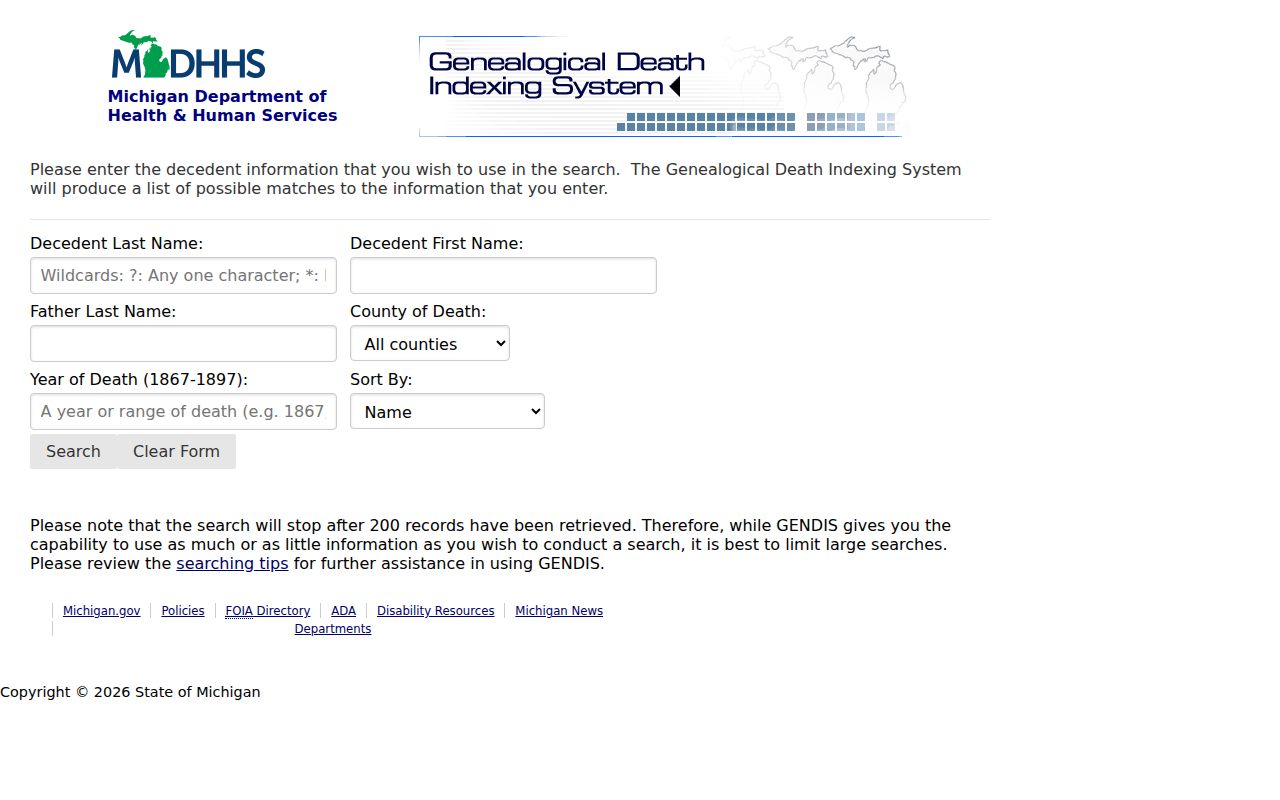
Michigan's Genealogical Death Indexing System is known as GENDIS. It is an early lead rather than a present-day location tool. It holds more than 460,000 Michigan death records from 1867 through 1897, and all were transcribed from microfilmed death ledgers. The form takes a decedent last name with single- or many-character wildcards. It also takes a first name, the father's last name, county of death, a year or year range, and a sort order. Broad searches stop at 200 results. A county or year narrows the work.
The GENDIS search form displays the name, county, and year controls. These support a historical Portage name search. Use it to spot a possible death-index entry. Then weigh that entry against a local record or a family source.
The Heritage Room at Portage District Library is a second channel. It serves when a name needs local context. The room holds local history materials and a Local Historian. Many fragile or archival items stay room-use-only. Kalamazoo Valley Genealogical Society volunteers have assisted there. WMU Regional History Collections adds newspapers, photographs, public records, diaries, and other southwest Michigan material. Access comes through reading-room research. A 2026 WMU project is making Kalamazoo County Poorhouse ledgers from 1885 to 1912 more searchable. But a surname-and-age lead helps only after a county connection is established.
Portage State Name Checks
Michigan's official systems serve separate purposes. The Michigan Voter Information Center asks for first name, last name, birth month, and birth year. That runs its voter-information search. Registration records are public under FOIA. Driver-license or state-ID numbers, month and day of birth, and telephone numbers stay withheld. A voter record can confirm election registration details and jurisdiction. It cannot prove someone currently lives at an address.
For a regulated credential or entity connection, LARA's license search lets you query by License Type, License Number, First Name, Middle Initial, Last Name, Business Name, DBA Name, and County. The MiBusiness Registry replaced the older CID/PIN workflow on June 23, 2025. It now handles public entity records, annual reports, and copy orders. These systems establish limited filing or status facts, not a personal history.
An agency may hold a city record that is not on its public portal. Portage allows a focused request through the Michigan Freedom of Information Act process. Michigan FOIA, 1976 PA 442, MCL 15.231 et seq., generally calls for a response within five business days. One ten-business-day extension is permitted. A Portage request may arrive by email, fax, mail, in person, or as a documented verbal request. It must describe the record well enough to identify it. Court records follow court access rules instead.
Portage Resident Lookup Limits
Every resident lookup tool has blind spots, and Portage is no different. MiCOURT shields certain case categories from public view. Probate excludes sequestered records and posts no images online at all. Portage property data refreshes daily, yet the county makes no promise of accuracy. Land records go back to 1831, an impressive span. But complete indexing stops at 1984. So older name searches may require help from staff. A cemetery record documents an interment only, never a home address. A ZIP match proves nothing about who actually lives there. Likewise, a tax mailing address proves nothing about who actually lives there.
A missing address sometimes has a lawful explanation. Michigan's Address Confidentiality Program, established by 2020 PA 301, MCL 780.851 et seq., gives qualifying survivors and at-risk applicants a substitute address, mail forwarding, and protection for government records. The program is a shield, not a search aid. Nobody should treat a substitute address as a lead to a physical location. Its presence simply signals a safety measure, not an absence of any Portage connection.
Lawful use. Use Portage records for personal, lawful research such as family history, estate questions, civic records, or confirming an official filing. Do not assemble sensitive details, repeatedly contact someone, or use a result to stalk, harass, intimidate, or harm any person.
Found a mistake in a record? Take it to the custodian who holds it. City material belongs with the Portage City Clerk. County holdings go to the County Clerk or the Register of Deeds, voter records to the Michigan Secretary of State, vital records to the registrar, and court files to the court clerk. When you write, include the source URL, the record date, the record type, and the jurisdiction so the fix lands in the right hands.